If your team is fully remote or hybrid, the away day has quietly become one of the most important days in your operating year. It's often the only time the whole team is physically in the same room - and for many distributed organisations, the only time some colleagues meet at all. That makes it both more valuable and more pressured than the away days of a decade ago.
The temptation, understandably, is to pack the day with everything you can't do over Zoom: strategy, planning, social bonding, training, town hall updates. The result is usually a day that feels busy but doesn't build the one thing remote teams actually need - genuine trust between people who otherwise only know each other as faces in a video grid.
Why remote teams need away days differently
The research on distributed teams is consistent on one point: the work itself can be done well remotely, but the relational foundation that holds a team together erodes without periodic in-person contact. Trust, psychological safety and shared identity are harder to build through screens. Amy Edmondson's work on psychological safety describes it as a shared belief that a team is safe for interpersonal risk taking, and that belief is built through the small, unguarded moments that video calls have almost none of.
This isn't an argument for going back to the office. It's an argument for being deliberate about what in-person time is for. When you only have one or two days a year together, those days have to do specific work - and that work is mostly relational, not operational.
The mistake most remote teams make
The most common mistake is treating the away day as a more efficient version of normal work. The team is finally together, so let's get through the strategy deck, the quarterly review, the product roadmap, the values workshop, and have a nice dinner.
The result is a day where people sit through presentations they could have watched asynchronously, and barely have an unstructured conversation with each other. They leave tired, with full notebooks, and no closer to the colleagues they came to see.
The strategy work matters. It just doesn't need to happen in the room where you've finally got everyone together.
What in-person time is genuinely good for
Four things happen more easily in person than remotely, and these are what your away day should be designed around:
- Reading each other. Subtle signals - tone, body language, who defers to whom, who lights up when - are largely invisible over video. Time in the same physical space recalibrates how team members read one another.
- Unstructured conversation. The conversations that build trust happen in the gaps - walking between sessions, over lunch, during the slightly awkward ten minutes before dinner. Remote work has almost no gaps. An away day should have lots.
- Difficult conversations. Disagreement, feedback, naming tensions - all of this is harder over video and easier face-to-face. If there's something unsaid in the team, in-person time is where it can finally be said.
- Shared physical experience. Doing something together that requires presence - walking a landscape, eating a meal cooked from the place you're in, sitting around a fire - creates shared memory in a way that a workshop in a hotel function room does not.
Designing a day that builds remote trust
Five principles tend to make the difference between an away day that remote teams remember and one they don't.
1. Strip the agenda right back
Resist the urge to use the time efficiently. A remote team's away day should feel deliberately spacious. Two or three substantial conversations, with real space between them, will do more than eight tightly-scheduled sessions.
2. Move the strategy work to a different day
If you need to do annual planning or a roadmap review, do it on a separate remote day before or after. Don't burn your scarce in-person time on work that can happen on screen. Use the in-person day for the conversations that can only happen in person.
3. Choose somewhere that isn't a hotel
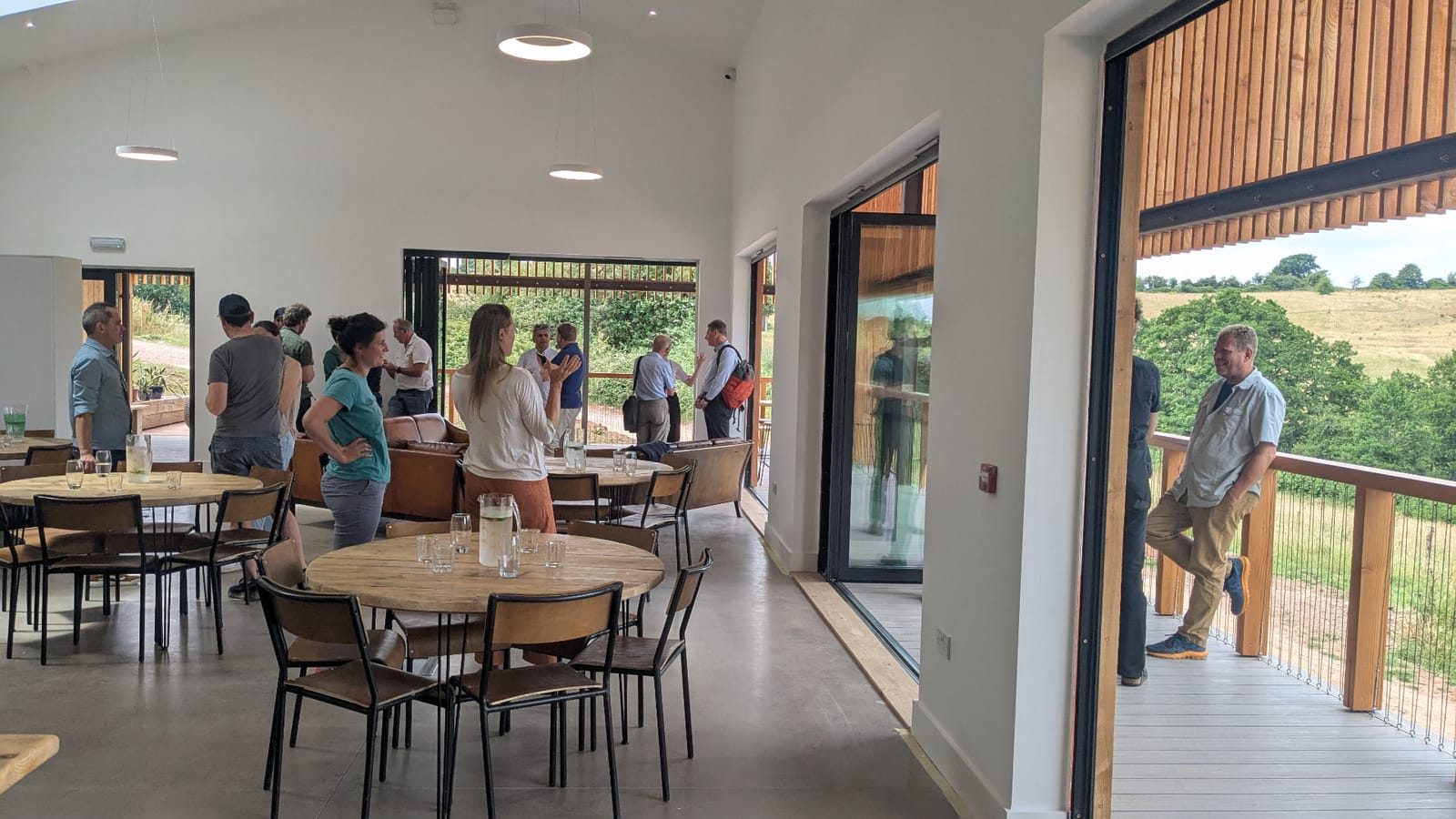
The physical environment shapes the conversation more than people expect. A landscape, a working farm, a place with character - these create a different quality of attention and presence than a corporate meeting room. For remote teams in particular, going somewhere genuinely elsewhere helps mark the time as different from normal work.
4. Use a skilled facilitator
The temptation when you've finally got everyone together is for the leader to run the day themselves. Don't. A leader running their own away day cannot also be a participant - and the most important conversations are the ones where the leader needs to be in the room, not at the front of it. A skilled external facilitator, ideally with a psychological background, makes the difficult conversations possible. We have written separately about why facilitation is the half of the equation most teams skip.
5. Build in unstructured time
Long lunches. A walk between sessions. An evening where nothing is scheduled. These are not gaps in the day; they are the day. The relational work that remote teams need most happens in unstructured time, not in workshops.
How often, and for how long?
Most remote teams we work with land on one of two patterns:
- Annual two-day offsite for the whole team, with a night together in the middle. The overnight matters - the conversations after dinner are often the ones that change the team.
- Quarterly one-day gatherings for smaller leadership groups, with an annual longer offsite for the whole company.
One-day away days work for established remote teams that already know each other well. For newer teams, or teams that have grown significantly since their last gathering, an overnight is almost always worth the additional cost. The hours between dinner and breakfast do a kind of relational work that a day on its own cannot replicate.
Measuring whether it worked
The honest measure of a remote team's away day isn't the feedback form filled in on the journey home. It's what's different six weeks later. Two practical signals to watch for:
- Are people reaching out to each other directly more often? A good away day creates relational permission. You should see more cross-team DMs, more informal calls, more people picking up the phone instead of waiting for the next scheduled meeting.
- Are difficult things being said sooner? Remote teams often let tensions accumulate because raising them over video feels disproportionate. After a good in-person day, things tend to get named earlier.
If neither of these is true six weeks on, the day was probably a nice break rather than a genuine intervention.
The bigger picture
For remote and distributed teams, in-person time is no longer an extra. It's structural. The companies who treat it that way - protecting it, designing it carefully, refusing to fill it with operational work - are the ones whose remote teams hold together over years rather than months.
If you are thinking about an in-person day or overnight for your distributed team, we would be glad to talk it through. Wilder Away Days runs facilitated days and overnight retreats on an 80-acre rewilding landscape in South Wales, designed specifically for the relational work that remote teams need in-person time to do. You can see how we run retreats for distributed teams, check what a day costs, read our breakdown of what a corporate away day costs in the UK, or book a discovery call.